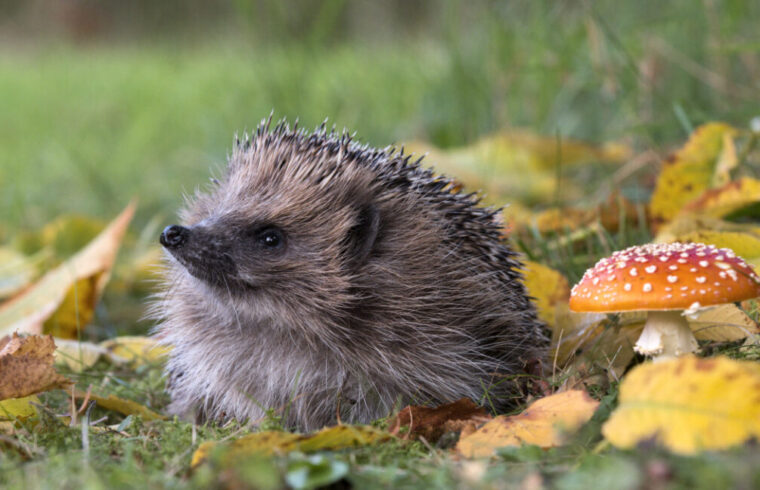
Imagine trying to find a tiny, nocturnal creature like a hedgehog across an entire country. Sounds impossible, right? You certainly can’t spot one directly from space! But what if you could find their favorite hiding spots, their cozy homes, their supper tables, all from orbit? That’s the brilliant premise behind groundbreaking ongoing research at the University of Cambridge. Scientists there are turning satellite imagery and cutting-edge AI models into digital detectives, mapping potential hedgehog habitats across the UK by first identifying their most beloved, thorny hideaways: bramble patches.
This isn’t just a clever technological feat; it’s a vital mission. Our endearing European hedgehog populations have tragically declined by a staggering 30 to 50 percent over the past decade. It’s a silent crisis unfolding right under our noses, or more accurately, in the overgrown corners of our landscapes. Tracking these shy, nocturnal little mammals across vast, complex areas has always been an incredibly difficult and expensive endeavor. So, instead of embarking on a hopeless quest to spot the hedgehogs themselves, researcher Gabriel Mahler and his team developed an ingenious AI model. This model, trained on satellite data, can pinpoint brambles – those dense, thorny shrubs that serve as critical refuges for hedgehogs – with remarkable accuracy. It’s a bit like finding a valuable treasure by locating the map it’s drawn on, isn’t it?
The Vanishing Prickly Pal: A Race Against Time
Have you noticed fewer hedgehogs rustling through your garden at dusk? It’s not just your imagination. The decline of these iconic creatures is a serious concern, reflecting broader ecological challenges. Habitat loss, fragmentation of landscapes, the use of pesticides reducing their insect prey, and even increased road traffic all play a role in their struggle. These small mammals are incredibly vulnerable, and without intervention, we risk losing them from our ecosystems forever. It’s a sobering thought, especially when you consider how much joy a glimpse of a hedgehog can bring.
The traditional methods for monitoring wildlife, such as manual surveys, trapping, or radio tagging, are labor-intensive, time-consuming, and often financially prohibitive, especially when we’re talking about an entire country. For creatures that prefer to stay out of sight and do most of their activity under the cover of darkness, getting an accurate population count or even understanding their distribution is a Herculean task. This is where innovation steps in, offering a glimmer of hope in the conservation battle.
A Hedgehog in a Bramble Patch: Unlocking Nature’s Secrets with Tech
Why Brambles? Unpacking the Hedgehog’s Favorite Hideaway
So, why focus on something seemingly as ordinary as a bramble bush? Well, to a hedgehog, a bramble patch isn’t just a cluster of thorns; it’s a five-star hotel, a fortress, and a buffet all rolled into one! These dense thickets provide essential daytime shelter, protecting them from predators like badgers and foxes while they snooze. They’re also prime locations for nesting, offering safe havens for raising their young. Beyond shelter, brambles are ecological magnets. They attract a plethora of insects and provide delicious berries, which in turn support the invertebrate populations that form the bulk of a hedgehog’s diet. Think of it as a crucial pillar in their tiny ecosystem – without the brambles, the whole structure crumbles.
This understanding forms the bedrock of the Cambridge research. Instead of trying to find the impossibly small target, Gabriel Mahler and his team wisely shifted their gaze to the habitat itself. By leveraging the unique spectral signature of brambles – how they reflect light across different wavelengths – satellites can ‘see’ them, even when human eyes can’t make sense of the vastness. It’s an elegant solution to a complex problem, proving that sometimes, the best way to find something is to look for where it isn’t.
Seeing the Unseen: AI and Satellites to the Rescue
How Does AI “See” Brambles from Space?
This isn’t science fiction; it’s the incredible power of modern technology! Satellites orbiting our planet are constantly capturing detailed images of the Earth’s surface. These images contain far more information than just what our eyes perceive; they capture data across the electromagnetic spectrum. Different plants reflect and absorb light differently, creating unique “fingerprints” – their spectral signatures. Brambles, with their specific leaf structure and growth patterns, have their own distinct signature.
Gabriel Mahler’s team trained an AI model, a sophisticated machine learning algorithm, to recognize these patterns. They feed the AI vast amounts of satellite data, essentially teaching it what a bramble patch looks like from hundreds of miles up. The AI then uses this learned knowledge to scan new satellite images, identifying and mapping every potential bramble location with remarkable speed and accuracy. This allows researchers to quickly process data for huge areas, far beyond what any human team could cover on the ground. It’s like having an army of tireless, super-intelligent botanists scanning the entire landscape, tirelessly searching for our spiky friends’ homes!
Beyond Just Mapping: The Bigger Picture for Conservation
The implications of this research stretch far beyond simply drawing dots on a map. This detailed, large-scale mapping of hedgehog habitats provides invaluable data for conservationists and policymakers. We can identify priority areas for protection, target efforts for habitat restoration (like planting more hedgerows and brambles!), and understand how landscape changes are impacting these creatures. The data can also inform urban planning, ensuring that new developments consider and protect vital wildlife corridors. This isn’t just about observing; it’s about acting with precision and purpose to reverse the decline.
What This Means for Us (And Our Prickly Friends)
Why should we care about brambles and hedgehogs from space? Because it speaks to a larger truth: technology, when wielded thoughtfully, can become a powerful ally in the fight to protect our planet’s biodiversity. It shows us that even the most seemingly insurmountable conservation challenges can be tackled with innovative thinking and the right tools. It also reminds us of the intricate web of life – how the health of one small species can be linked to the plants they rely on, and how human ingenuity can step in to mend broken connections.
This research offers a beacon of hope. It demonstrates that with the power of AI and satellite technology, we can gain an unprecedented understanding of our natural world, enabling us to make informed decisions that safeguard species like the European hedgehog. It’s a testament to the fact that when humanity puts its brightest minds to work for nature, truly extraordinary things can happen. So, the next time you see a bramble patch, perhaps you’ll think of the clever AI in the sky, silently working to protect the tiny, spiky inhabitants below.