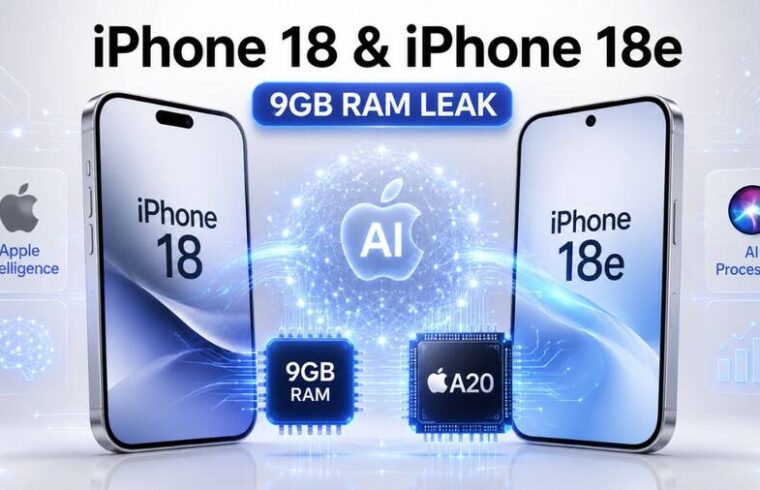
Hey there, tech enthusiasts and Apple aficionados! Have you ever wondered what truly fuels the next generation of your favorite iPhone? We’re talking about the raw power that makes those mind-bending AI features sing. Well, get ready for some exciting news, because a fresh leak suggests the upcoming iPhone 18 and iPhone 18e are gearing up for a significant internal upgrade, specifically designed to supercharge Apple Intelligence.
Our trusty insider, the highly respected TF International Securities analyst Ming-Chi Kuo, has dropped a bombshell via a post on X (formerly Twitter): both the standard iPhone 18 and its more budget-friendly sibling, the iPhone 18e, are expected to land with a robust 9GB of RAM. Now, if you’re keeping score, that’s a sweet 1GB jump from the 8GB found in the current iPhone 17 and iPhone 17e models. So, what does a single gigabyte really mean in the grand scheme of things?
The 1GB Difference: A Small Jump, a Giant Leap for On-Device AI
You might be thinking, “Just 1GB? Is that really such a big deal?” And we hear you! But when it comes to the intricate dance of modern smartphone performance, especially with cutting-edge artificial intelligence, every single byte counts. Think of your iPhone’s RAM as its short-term memory, or perhaps its personal workspace. The more space it has, the more tasks it can juggle simultaneously, and the more complex calculations it can perform without breaking a sweat.
This subtle yet strategic increase in RAM is all about facilitating a much smoother and more responsive experience for Apple’s ambitious and rapidly expanding AI capabilities. With iOS 27, Apple introduced its most sophisticated on-device AI system to date – Apple Intelligence – for the very first time. This isn’t just a fancy software trick; it’s a fundamental shift that demands more from the hardware. And that, my friends, elevates the significance of memory like never before for future iPhones.
Beneath the Hood: A Smarter Memory Layout for Enhanced Performance
Kuo didn’t just stop at the RAM capacity; he also offered a peek into how Apple might be orchestrating this memory upgrade. The leak suggests that the iPhone 18 and iPhone 18e could come equipped with six 1.5GB DRAM chips, a departure from the four 2GB chips typically found in the latest models. This isn’t merely about adding more memory; it’s about optimizing how that memory is structured and utilized.
This configuration could provide Apple with greater flexibility and a chance to truly fine-tune how its upcoming devices manage their memory resources. It’s a testament to Apple’s philosophy of continuous hardware enhancements, often preferring impactful, iterative improvements over purely dramatic, headline-grabbing yearly changes. This ensures that every upgrade serves a purpose, laying a solid foundation for more powerful software experiences.
Powering the Future: The A20 Chipset and TSMC’s 2nm Tech
Of course, memory doesn’t work in isolation. The leaks also indicate that both the iPhone 18 and iPhone 18e will feature Apple’s formidable, next-generation A20 chipset. This isn’t just any chip; it’s anticipated to be produced using TSMC’s groundbreaking 2nm Gate-All-Around (GAA) process. What does this mean for you, the user?
Imagine a world where apps launch even quicker, where your gaming sessions are buttery smooth, and multitasking feels effortless. The A20 chip, crafted with this cutting-edge manufacturing process, is expected to deliver more powerful performance while simultaneously consuming less power than today’s chips. This translates directly into better battery life – a win-win in anyone’s book, right?
More importantly, the A20 chip will be a pivotal player in processing a greater number of AI tasks directly on your device, significantly reducing reliance on cloud-based processing. This synergy between the advanced chip and increased RAM is what truly unlocks the potential of on-device AI.
Apple Intelligence: Privacy, Power, and Your Personal Assistant
If you’ve been following Apple, you’ll know that iOS 27 was a landmark release, unveiling a profoundly more capable on-device AI. This isn’t just about Siri getting a bit smarter (though she certainly does!). We’re talking about a comprehensive AI system woven into the very fabric of the operating system, designed to execute complex tasks without constantly pinging external servers.
Picture this: more intelligent and contextual Siri conversations, enhanced writing support that polishes your prose, vastly improved voice recognition, and smarter dictation. Envision your iPhone offering intelligent text editing and providing context-aware suggestions across all your apps. These are just a few facets of what Apple Intelligence brings to the table.
But here’s the kicker: running these features locally isn’t just about speed; it’s a huge win for privacy. Keeping your personal information and processing on your device means your data stays local, under your control. This commitment to on-device processing and user privacy is a core tenet of Apple Intelligence, but it comes at a hardware cost – it needs more muscle, specifically, more memory.
The Memory Mandate: Why 9GB is Still a Stepping Stone
Apple has explicitly stated that its most advanced AI models for on-device processing demand a unified memory of at least 12GB. This explains why some of Apple’s most sophisticated AI experiences are currently limited to a select few, high-end devices. We’re talking about the iPhone 17 Pro and iPhone 17 Pro Max, newer iPads sporting M4 chips (or newer) with 12GB+ memory, recent Macs with M3 chips (or newer) and 12GB+ unified memory, and of course, the Apple Vision Pro with its M5 chips.
Given this, the 9GB in the iPhone 18 and 18e might seem like it still falls short of that 12GB threshold for the absolute peak of Apple Intelligence. However, it’s a crucial step in the right direction, significantly improving the baseline AI experience for mainstream iPhone users. It demonstrates Apple’s clear strategy: gradually integrate Apple Intelligence into the core iPhone experience and systematically upgrade the hardware to support its escalating capabilities.
What’s Next for the iPhone 18?
While the official launch is still some months away (with reports suggesting a release in the first half of 2027 for the standard models, possibly after the Pro models in September), you can bet your last dollar that more leaks and tantalizing details are on their way! We’ll likely uncover more about the iPhone 18’s displays, camera innovations, battery life, and even more nuanced AI features.
Assuming Ming-Chi Kuo’s latest forecast holds true, the iPhone 18 line isn’t just another annual refresh. It represents a vital piece of Apple’s larger puzzle – a strategic move to embed Apple Intelligence deeper into the very soul of the iPhone, making advanced AI more accessible and powerful for millions worldwide. Are you excited to see how this memory boost translates into real-world AI magic? Let us know what you think!