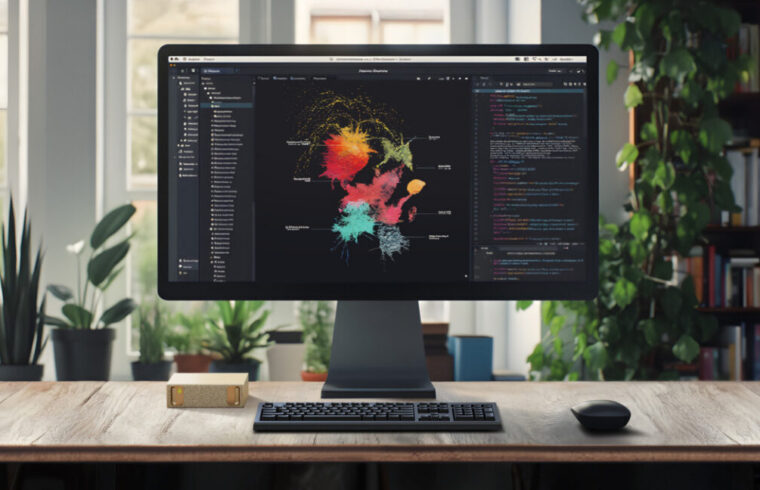
Are you an AI developer constantly striving to push the boundaries of innovation? Do you dream of training and experimenting with colossal AI models right from the comfort of your workspace, without the complexities and costs often associated with massive data centers? Well, get ready, because your dream just got a whole lot closer to reality!
Nvidia, a name synonymous with cutting-edge graphics and AI acceleration, recently dropped a bombshell on the tech world. They announced the imminent availability of the DGX Spark, a revolutionary desktop AI computer that’s set to redefine what’s possible for individual developers and small teams. This isn’t just another powerful PC; it’s an entire AI supercomputing ecosystem, miniaturized and optimized for your desk. Priced at an accessible $4,000, it packs a serious punch that could genuinely transform your AI development workflow.
Igniting Innovation: What Makes the DGX Spark a Game-Changer?
Imagine harnessing the power of a data center, right there beside your coffee mug. That’s essentially what the Nvidia DGX Spark promises. This isn’t about incremental upgrades; it’s a categorical shift. Nvidia has engineered this machine to be a dedicated AI workstation, specifically designed to address the unique challenges and demands of modern AI development.
The Powerhouse Under the Hood: Performance and Memory Unveiled
Let’s talk specs, because this is where the DGX Spark truly shines. We’re talking about an astonishing one petaflop of computing performance. If you’re wondering what that means for you, it translates to an unimaginable speed for complex AI calculations, model training, and inferencing. This level of raw processing power, traditionally reserved for racks of servers, is now at your fingertips.
But performance isn’t just about speed; it’s also about capacity. The DGX Spark boasts an impressive 128GB of unified memory. Why is this so crucial for AI? Think of it this way: the bigger the AI model, the more memory it needs to operate efficiently. Consumer-grade GPUs, while powerful, often hit a memory wall when tackling truly massive models. The DGX Spark obliterates that barrier, allowing you to work with larger, more sophisticated AI architectures locally, without compromising on performance or stability. This is arguably its biggest selling point and a direct answer to a long-standing developer pain point.
Designed for Your Workspace: Form Factor and Accessibility
Perhaps one of the most surprising aspects of the DGX Spark is its physical footprint. Nvidia has managed to wrap all this immense power into a form factor small enough to comfortably sit on your desk. No need for server racks, specialized cooling, or dedicated machine rooms. This compact design means it integrates seamlessly into any office or home setup, making personal AI supercomputing a tangible reality for more people than ever before.
Who Benefits Most from This Desktop AI Marvel?
So, who exactly is the DGX Spark built for? If you’re an AI researcher, a data scientist, a machine learning engineer, or even a passionate AI enthusiast who’s tired of waiting for cloud instances or struggling with consumer hardware limitations, then this machine is speaking directly to you.
Bridging the Gap: Local AI Models vs. Cloud Computing
We all know the power of cloud computing for AI, but it comes with its own set of challenges: recurring costs, data privacy concerns, and latency. The DGX Spark offers a compelling alternative. By enabling you to run local AI models of significant scale, it gives you unparalleled control, immediate feedback, and the ability to iterate faster. Imagine developing and fine-tuning your most complex models without constantly monitoring your cloud bill or worrying about data egress fees. This desktop powerhouse truly empowers you to perform sensitive or proprietary AI development in a secure, local environment.
Beyond Consumer GPUs: Tackling Larger AI Models
For too long, serious AI development has been a trade-off: either incredibly expensive, specialized hardware or the limitations of consumer GPUs. While consumer cards are excellent for many tasks, their memory constraints often limit the size and complexity of the AI models you can effectively train or run. The DGX Spark directly addresses this by providing that generous 128GB of unified memory, unlocking the potential for groundbreaking work with next-generation AI architectures that simply wouldn’t fit on a standard desktop GPU.
The Journey of a Spark: From Project DIGITS to DGX Spark
The journey to the DGX Spark has been an exciting one for Nvidia. Many of us followed its initial reveal in January, where it was previewed under the intriguing codename “Project DIGITS.” This early glimpse promised a future where high-performance AI was more accessible. Later, in May, Nvidia formally unveiled and named it the DGX Spark, cementing its place in their prestigious DGX lineup of AI systems. This progression highlights Nvidia’s clear vision: to create a new, distinct category of desktop computer workstation specifically for AI development.
How to Get Your Hands on the Nvidia DGX Spark
Excited to add this marvel to your toolkit? Nvidia has made it straightforward to acquire. Orders for the DGX Spark are available directly through the official Nvidia website. In addition, you can also secure your own AI supercomputer from Nvidia’s trusted manufacturing partners and through select US retail stores. This multi-channel availability ensures that more developers and innovators can access this groundbreaking technology.
The Future of AI is Personal: Are You Ready?
The Nvidia DGX Spark isn’t just a new product; it’s a statement. It signals a future where the immense power of AI development is democratized, moving from exclusive data centers to individual desks. It’s an invitation to every ambitious AI developer to dream bigger, build faster, and innovate more freely than ever before. So, are you ready to spark your next big AI breakthrough?